
Fiche de dégustation à télécharge (pdf)
Aide-mémoire de dégustation à télécharge (pdf)
Le principe de base de la dégustation du vin est très simple :
- Il consiste simplement à être en mesure de goûter un vin,
- D’en reconnaître les sensations:
- Visuelles (l’oeil);
- Olfactives (le nez);
- Et gustatives (la bouche) ;
- Et enfin d’exprimer ces sensations à l’aide d’un vocabulaire approprié.
Pour y arriver, il suffit de se pratiquer et d’exercer nos sens à reconnaître les multiples sensations que procure le vin. Nos organes sensoriels peuvent différencier une grande variété de sensations.
- Il suffit de regarder et d’écouter le monde qui nous entoure pour réaliser la quantité de couleurs, de tons, de formes, de textures et d’intensités lumineuses, ou encore la multitude de son et de bruits que nous percevons pour s’en convaincre.
- Les organes du goût et de l’odorat ont des capacités semblables. Mais nous nous en servons moins.
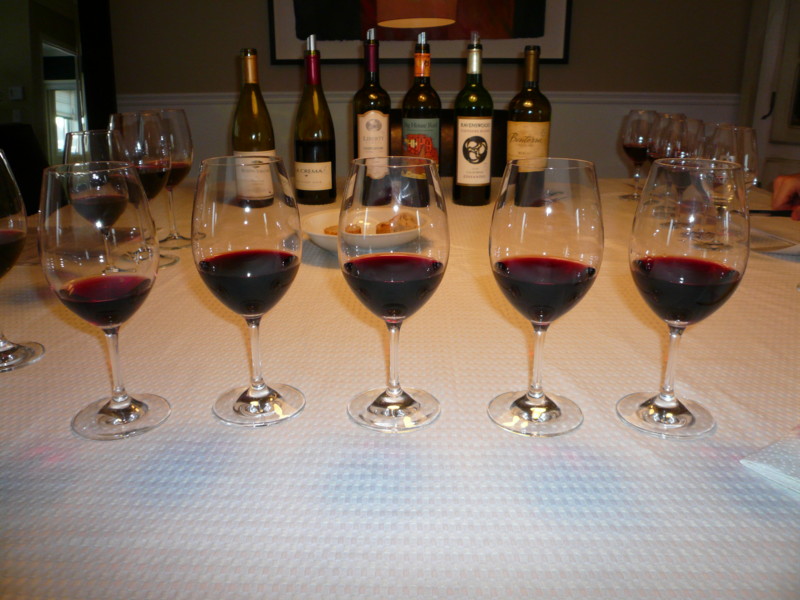
Éducation au goût
Durant notre éducation, nous ne sommes pas socialisés à les utiliser autant que la vue et l’ouïe, entre autres parce qu’ils ne jouent pas un rôle primordial dans la communication qui est à la base de l’existence même de la culture et de la vie en société.
Vocabulaire du vin
Apprendre à déguster le vin, c’est apprendre à développer son goût et son odorat à reconnaître des subtilités sensorielles. Apprendre à déguster le vin, c’est ensuite apprendre à transposer les sensations qu’il nous procure et à les communiquer à l’aide d’un vocabulaire précis.
Pour y arriver, il s’agit de maîtriser un vocabulaire qui, quoiqu’en disent certains, n’a rien de facétieux, mais consiste en une convention de termes variés permettant d’exprimer avec précision toutes les gammes de sensations que nous procure le vin.
Une pratique structurée
Comme dans toutes choses, pour y arriver, il s’agit de suivre quelques règles simples de la dégustation du vin et de se pratiquer un peu. Si personne ne devient Tiger Wood du jour au lendemain, tout le monde peut aisément développer les habiletés minimum nécessaire pour apprécier la pratique du golf. Il en va de même avec le vin.